


The 1708 Austria Julius-702 Silver Medal: A Rare Treasure of the Holy Roman Empire
A Glimpse into History
In 1708, during the height of the War of the Spanish Succession, the Holy Roman Empire struck a remarkable silver medal to commemorate one of its greatest military triumphs: the Siege of Lille. Known to collectors as the Julius-702, this large-format silver issue was never intended for circulation. Instead, it served as a victory medal, a symbol of imperial prestige, and a tangible reminder of a turning point in European history.
At the time, Emperor Joseph I of Habsburg reigned over a vast empire stretching across Central Europe. His generals—most notably the famed Prince Eugene of Savoy—led allied forces in a campaign that broke French dominance in Flanders. To mark the event, master engravers in Nuremberg produced this extraordinary medal, rich in biblical symbolism and martial imagery.
The Design: Symbolism in Silver
What makes the Julius-702 especially fascinating is its artistic complexity.
-
Obverse (Front): The design features the Tower of Babel, paired with a Latin inscription translating to “Let us confound their language, that they may not understand one another’s speech.” This biblical allusion cleverly symbolizes the disarray of France’s forces during the siege. The exergue inscription details the dates of Lille’s encirclement and capture in 1708.
-
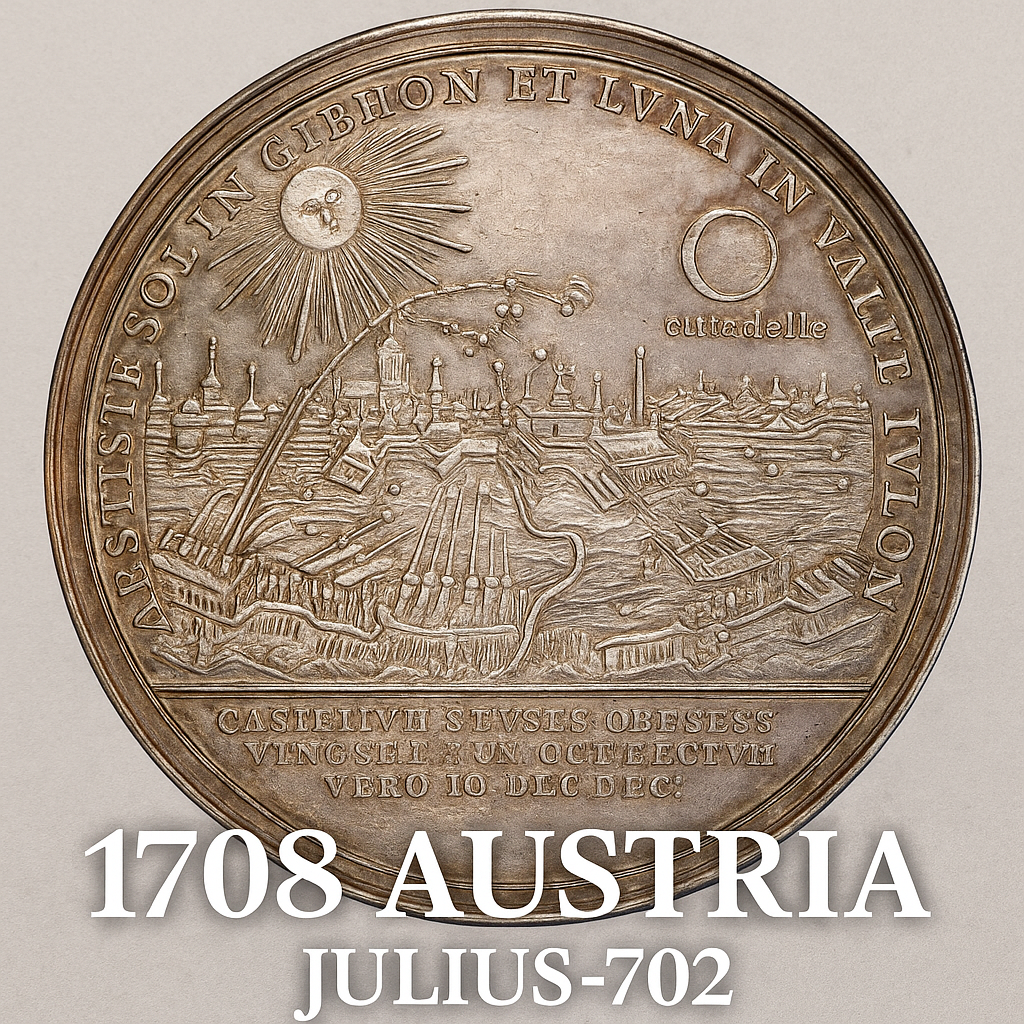
Reverse (Back): The reverse offers a breathtaking bird’s-eye view of Lille under siege. Cannons bombard the fortified city while the sun and moon preside over the scene—an explicit reference to the Book of Joshua, where the celestial bodies halt in the sky to ensure victory. The exergue records the final capitulation of the fortress. The rim inscription, “Virtus unita valet” (“Strength united prevails”), immortalizes the coalition’s triumph.
This was not a coin for commerce but a political statement in silver, combining art, scripture, and propaganda.
Specifications and Rarity
-
Year of issue: 1708
-
Mint: Nuremberg, Holy Roman Empire
-
Metal: Silver
-
Weight: ~37 g
-
Diameter: ~49 mm
-
Denomination: None (commemorative medal)
The original mintage is unknown, but scholars and dealers classify this issue as extremely rare (R3). In fact, third-party grading services confirm its scarcity: NGC records just a single certified specimen, graded MS62.
Market Appeal and Collecting Value
The Julius-702 has proven itself a star in the numismatic marketplace. Collectors and investors are drawn not only to its rarity but also to its sheer beauty and historical depth.
-
In 2025, an MS62 example sold at Stack’s Bowers for approximately ¥581,000 (USD ~$3,800)—a strong result for a non-denominated silver medal.
-
In 2011, another specimen graded Good EF realized 3,200 CHF in a Swiss auction, nearly double its estimate.
These records demonstrate consistent demand and suggest long-term appreciation potential. For high-net-worth collectors seeking diversification into tangible heritage assets, this medal represents a compelling opportunity.
Why It Matters Today
The Julius-702 is more than just a silver relic. It is:
-
A slice of history: encapsulating the clash between Habsburg and Bourbon dynasties.
-
A masterpiece of medallic art: showcasing the skill of German engravers at their peak.
-
An investment asset: scarce, desirable, and historically significant—qualities that drive value in today’s global coin market.
For collectors of the Holy Roman Empire or investors seeking rare, non-reproducible assets, the 1708 Austria Julius-702 silver medal stands as a timeless acquisition—an object where history, artistry, and financial value converge.